The Background
Good marketing isn't complicated in theory. You find out what your audience actually cares about, meet them in that place, and give them a reason to move. The hard part is that most people skip the first step and wonder why the second two don't work.
After enough projects, I've come to think of it as a sequence that can't be reordered: think clearly, design precisely, execute with discipline.It sounds obvious. It's surprisingly easy to break.
At Influcio, I learned to take the sequence seriously. Influcio is an AI influencer marketing platform. Its clients range from fast-growing e-commerce brands to companies like Temu and Luma AI. On any given week, the marketing work touched a lot of different surfaces: outreach strategy, campaign reporting, sales enablement, event materials, customer stories, service brochures. The range was wide. But the underlying question was always the same: are we actually talking to the right people, in the right language, about the right thing?
The Proof: Influcio x Shopline
Among Influcio's initiatives, the partnership with Shopline is the one that made that principle most visible, because we got to see what happened when we ignored it, and then what happened when we fixed it.
Shopline's platform gave influencers the infrastructure to build their own e-commerce storefronts. Influcio's role was to recruit influencers into the program and get them excited about building something of their own. On paper, a strong offer.
We started with Shopline's existing materials, polished and well-made, and sent 500 outreach emails.
Think: What Was Actually Going On
Before touching any creative, I wanted to understand why the first round failed so completely.
The answer wasn't hard to find once I looked from the influencer's side. Shopline's materials were built for brand founders and retail merchants. The language was about storefronts, inventory, and commerce infrastructure. That's not how an influencer thinks about their career.
Influencers think about their audience relationship, their personal brand, and whether a new opportunity is worth the risk of something unfamiliar. They're also pitched constantly, usually by people who want something from them. They've built very good filters.
Our outreach wasn't clearing those filters because it was speaking the wrong language. It wasn't a design problem yet. It was a positioning problem.
Audience Mismatch: Materials designed for retail merchants rather than career-focused creators.
Technical Friction: Focus on storefront infrastructure instead of audience relationship and personal brand growth.
Filter Failure:Outreach language that sounded like a generic “ask” rather than a strategic career opportunity.
Design: Speaking the Right Language
I rebuilt the messaging from the influencer's perspective, not the platform's. Three pillars held everything together:
1. Why own your brand
Focused on the long game. Collaborations are great, but they run on someone else's timeline and someone else's rules. Your own storefront compounds over time and doesn't disappear when a brand cuts its budget.
2. Why partner with us
Made the practical case. Not abstract benefits, but concrete ones: what tools they'd get, what support looked like, what the actual path forward was. Influencers are pitched vague promises constantly. Specifics stand out.
3. Incentives worth noticing
Gave them a near-term reason to act, beyond just the long-term vision.
I also designed materials tiered by pipeline stage, from awareness flyers that introduced the concept simply, to decision-stage content with success stories and program details. Someone who'd never heard of this shouldn't get the same thing as someone already considering it.
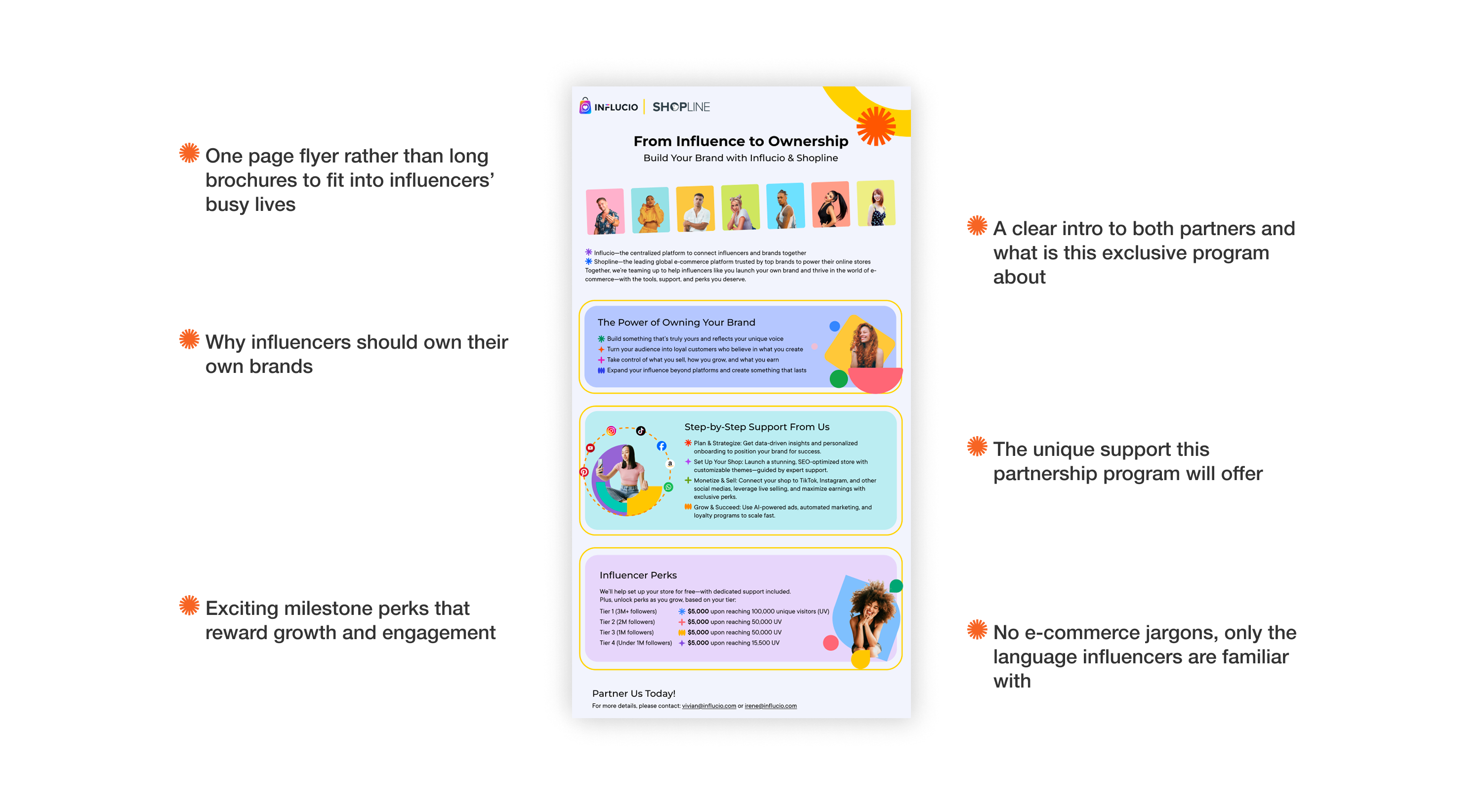
Awareness-stage flyer designed to introduce the concept simply and capture initial interest at the beginning of the pipeline.
Execute with Discipline
Rewriting the strategy is one thing. Making sure the actual outreach reflects it consistently is another. With the new materials in place, we sent out a fresh round of 100+ emails.
Up from 6% in the first round: a 3.3x improvement from repositioning alone.
Successfully onboarded significant volume drivers into the e-commerce program.
A 20% reply rate in cold outreach is not normal. It happened because we stopped asking influencers to care about what we cared about, and started talking about what they already cared about.
The Same Principle, Different Work
The Shopline case was the most visible proof, but the same sequence ran through everything I built at Influcio.
Lifecycle Marketing + Sales Enablement
Materials designed across the buyer journey
Each asset had a different job: introduce, educate, persuade, or keep the campaign moving.
01
Awareness
Make the service easy to understand quickly.
02
Consideration
Help prospects see the problem, proof, and fit.
03
Decision
Turn interest into a concrete buying conversation.
04
Activation
Support execution, reporting, and next-step momentum.
Strategy decks for influencer campaigns started with understanding what brands actually needed to see, not just what was easy to report.

Strategy deck slides staged as a premium sales-material mockup.
Campaign performance reports were written so a client could read them and immediately know what to do next.
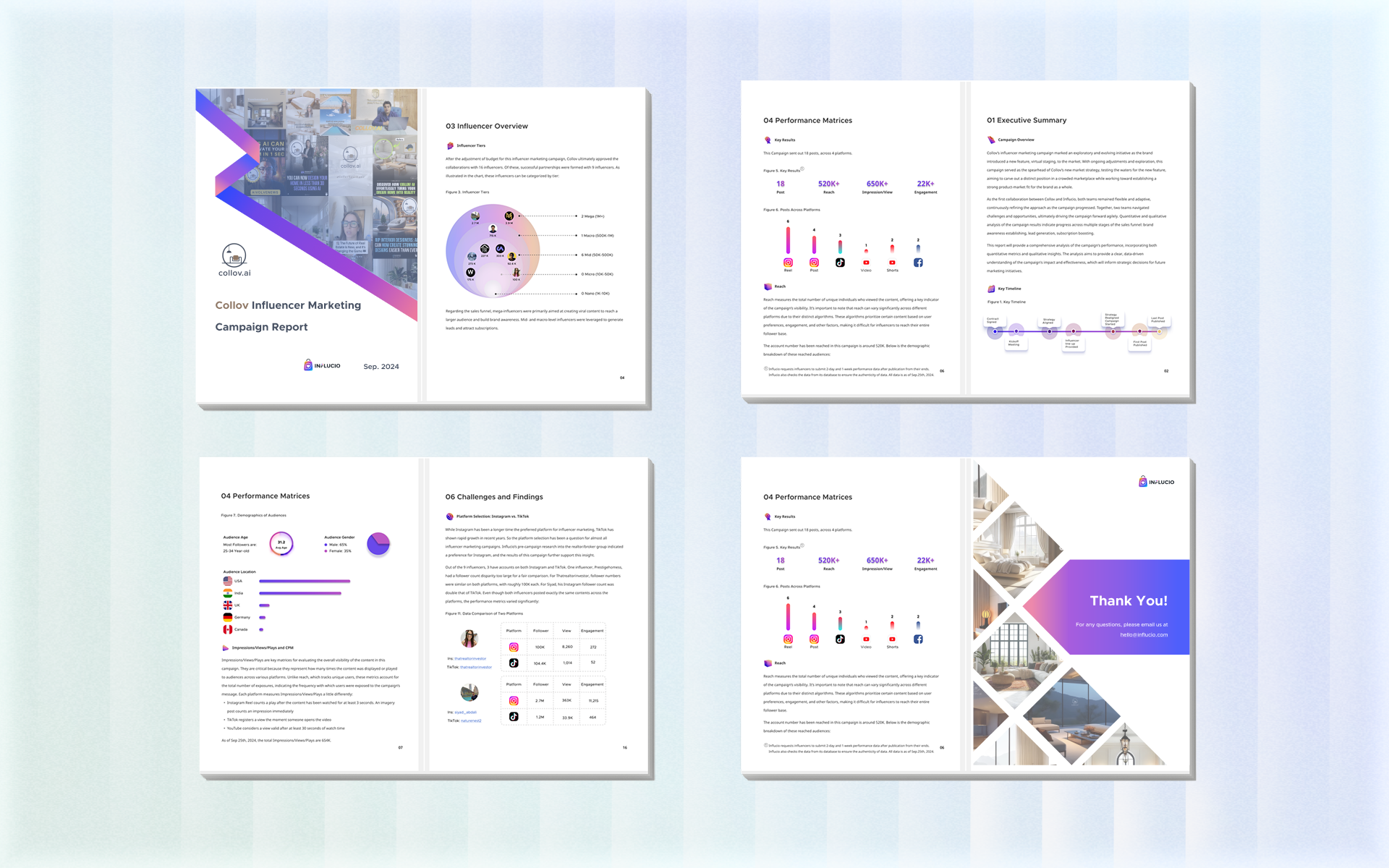
Reports designed for rapid comprehension and decision-making.
Customer success storieswere framed around the reader's problem, not the client's achievement.
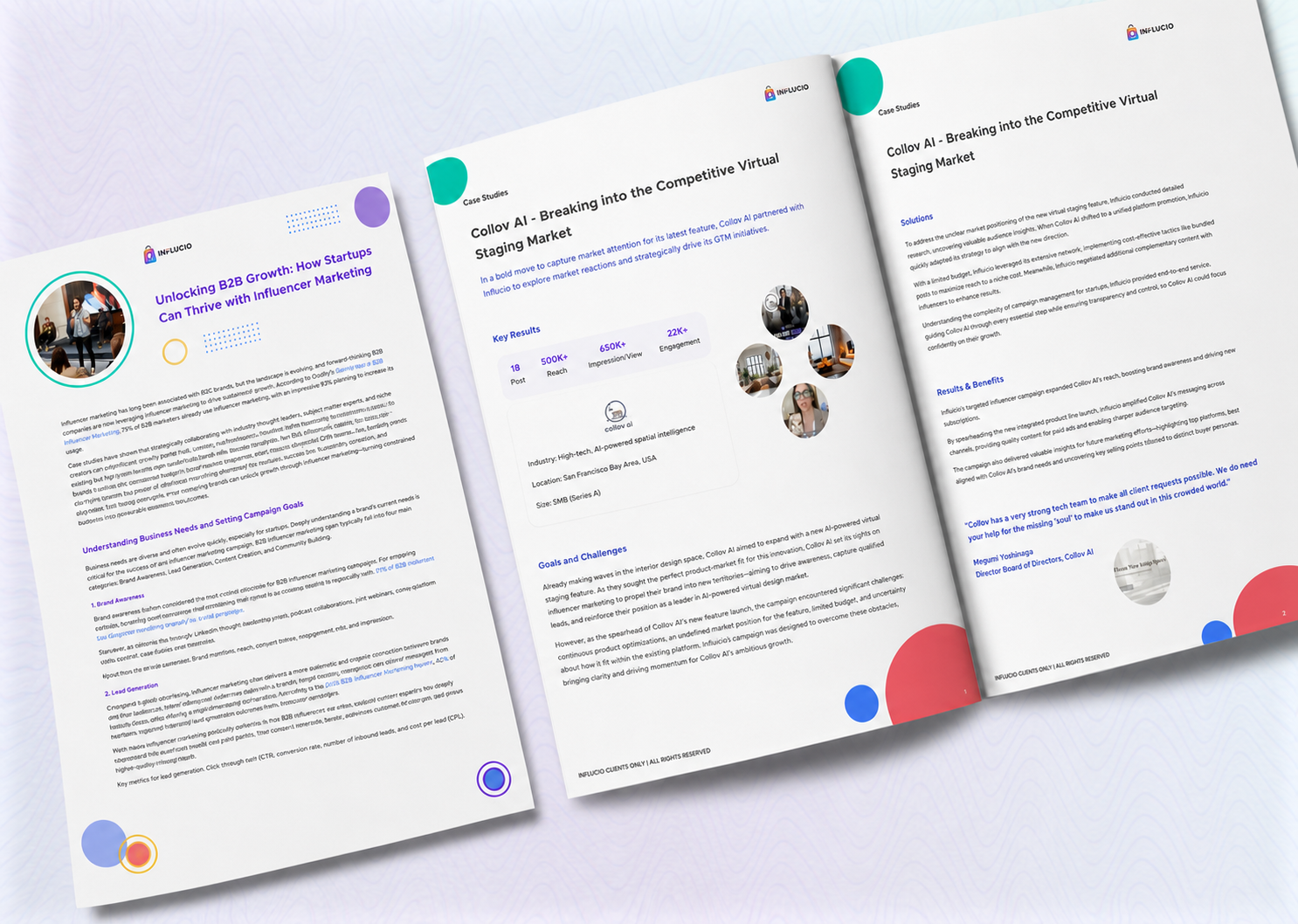
Problem-first customer stories arranged as a premium editorial mockup.
Service brochuresbuilt for events like CES had to work in five seconds of someone's attention, so every word and visual had to earn its place.
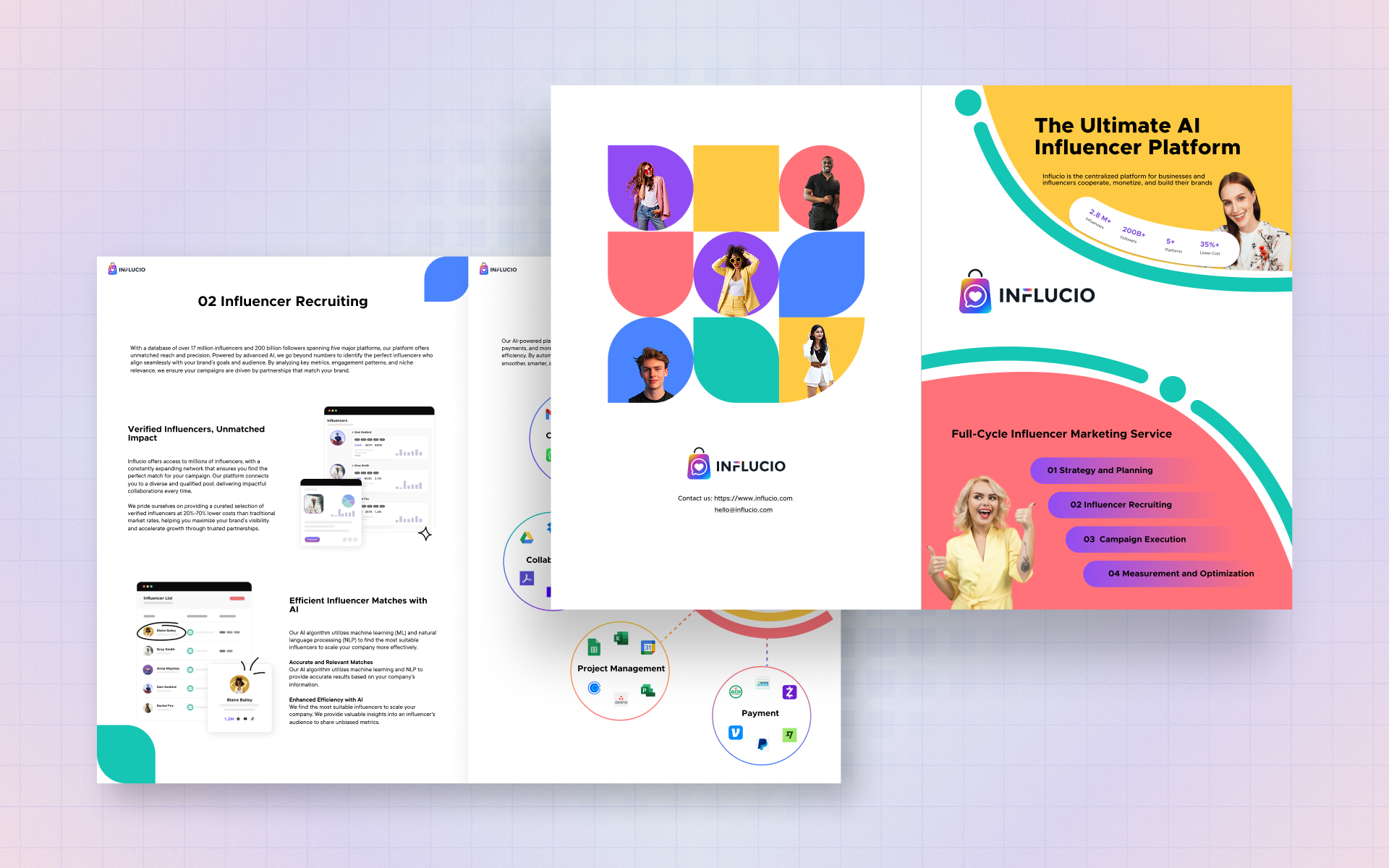
Event-ready brochure pages that made the recruiting workflow and campaign execution model legible at a glance.
Different deliverables. The same underlying logic:
understand who you're talking to, make something that lands with them, and follow it all the way through.