Project Overview
Chinese culture deeply values the wisdom of “accumulating little by little.” The name One Grain (一粟) carries that spirit. Just as grains accumulate one by one to fill a granary, characters learned daily build the foundation for real reading ability.
One Grain is a character reinforcement tool designed for Chinese learners. Characters are the foundational building blocks of the language, yet the transition from spoken fluency to reading literacy is often where progress stalls. When phonetic aids like Pinyin are removed, reading confidence can collapse, leading to character forgetting and quiet disengagement.
The tool is not a full Chinese learning platform, but a daily reinforcement habitdesigned to slot into a learner's existing routine for 5 to 15 minutes a day. It occupies the space between classroom instruction and independent reading, providing the scaffolding memory needs to reach fluent recognition.
The experience is calm, focused, and encouraging. There are no timers, leaderboards, or score penalties. Every design decision, from the muted color palette to the absence of sound effects, is calibrated to reduce anxiety and build the quiet confidence that encourages daily return.
Each learning session follows a disciplined three-part structure that progresses from atomic characters to full context: Characters, Words, and Sentences. First, individual characters are reviewed through recognition-first flashcards. Then, common word combinations are tested through multiple-choice vocabulary. Finally, a single complete sentence closes the session, serving as proof that the learner can read something real today.
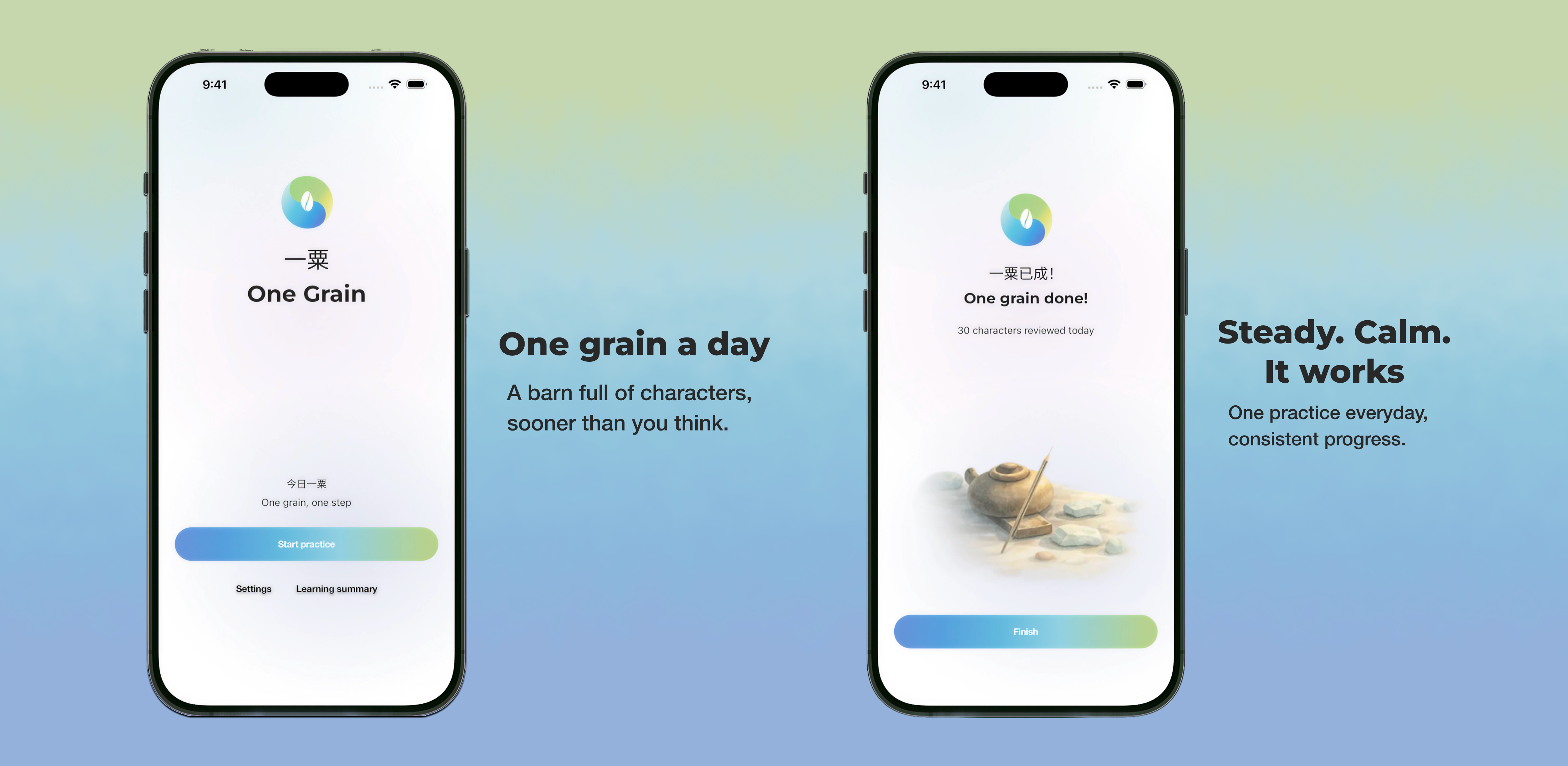
Left: The home screen opens with a single call to action, free from streaks or guilt. Right: Session completion is celebrated with a culturally warm watercolor illustration, allowing the learner to feel their progress without needing a score.
The Challenge: Quiet Disengagement
The problem of forgetting characters is structural in Chinese. As a logographic script, speaking fluency does not automatically transfer to reading fluency. Many learners communicate well but struggle to decode text once Pinyin support disappears.
This transition is often a breaking point. Without stable character memory, recall drops quickly. Many learners do not quit dramatically, but instead disengage quietly. Over time, a memory issue can turn into a belief that they are “just not good at Chinese.”
Existing tools rarely solve this well. Gamified apps often optimize for streaks, textbooks typically lack daily reinforcement, and many flashcards strip characters from their real word or sentence context, creating brittle memory.
I identified two primary dimensions for the design challenge:
- Cognitive: Designing a system that maximizes long-term character retention within a short, daily session without creating overwhelming review debt.
- Emotional: Designing an experience that a learner with existing character anxiety will actually want to open again tomorrow.
I made an early decision that shaped every subsequent choice: confidence preservation takes priority over learning efficiency. A system that teaches more characters but causes a learner to quit after two weeks is fundamentally less effective than one that teaches fewer characters but sustains daily usage for months.
System Architecture: Characters, Words, and Sentences
Before designing any screens, I translated the pedagogical requirements into a deterministic learning system. The objective was to create an architecture that felt simple to the learner while remaining rigorous underneath.
Part 1: Characters as the Atomic Unit
Character review stays at the core of every session. Each character exists in one of three internal states:
A Spaced Repetition System (SRS) schedules when each character reappears, with intervals that adjust based on the learner's self-rating after each review. The flashcard interaction follows a strict four-state machine:
The character is shown alone first. The learner is invited to attempt recognition before they are helped. On tap, the audio icon, Pinyin, meaning, and example words appear together. After the audio has been engaged, four rating buttons appear, ranging from Not yet to Super easy, which drive the SRS engine.
Session fill order is deterministic. Overdue reviews are addressed first, then due-today reviews, and finally new characters fill any remaining capacity. This ensures review debt never silently accumulates.
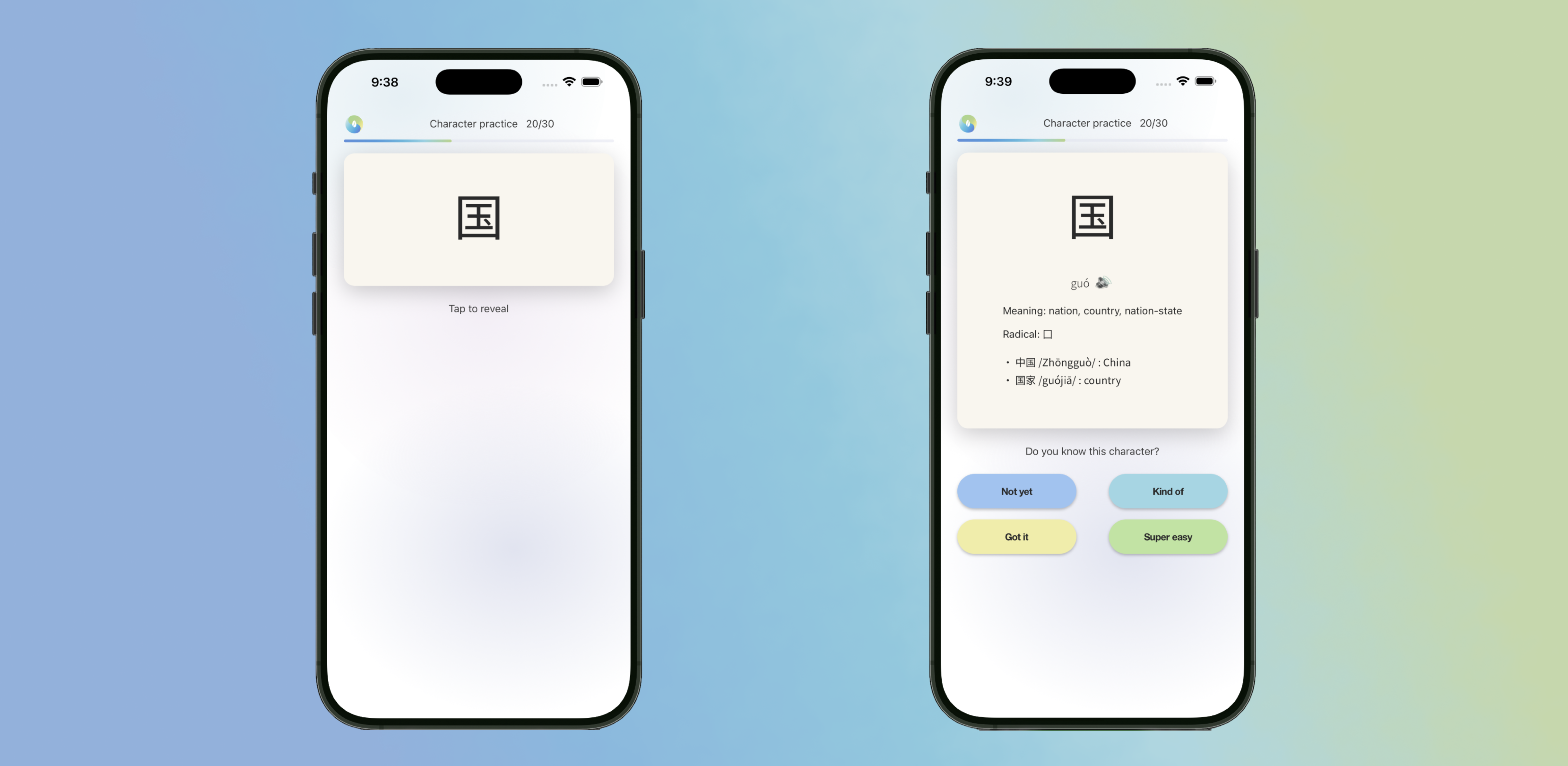
Front: The character appears alone to invite independent recognition. Back: A tap reveals the audio and Pinyin, allowing the learner to engage at their own pace.
Part 2: Words for Contextual Reinforcement
Following the individual character review, vocabulary questions anchor the abstract characters to words the learner already knows from spoken language. Feedback is immediate but gentle. A correct answer receives a soft green confirmation without fanfare, while a wrong answer receives a subtle highlight and a simple prompt to try again. Failure is treated as data, not punishment.
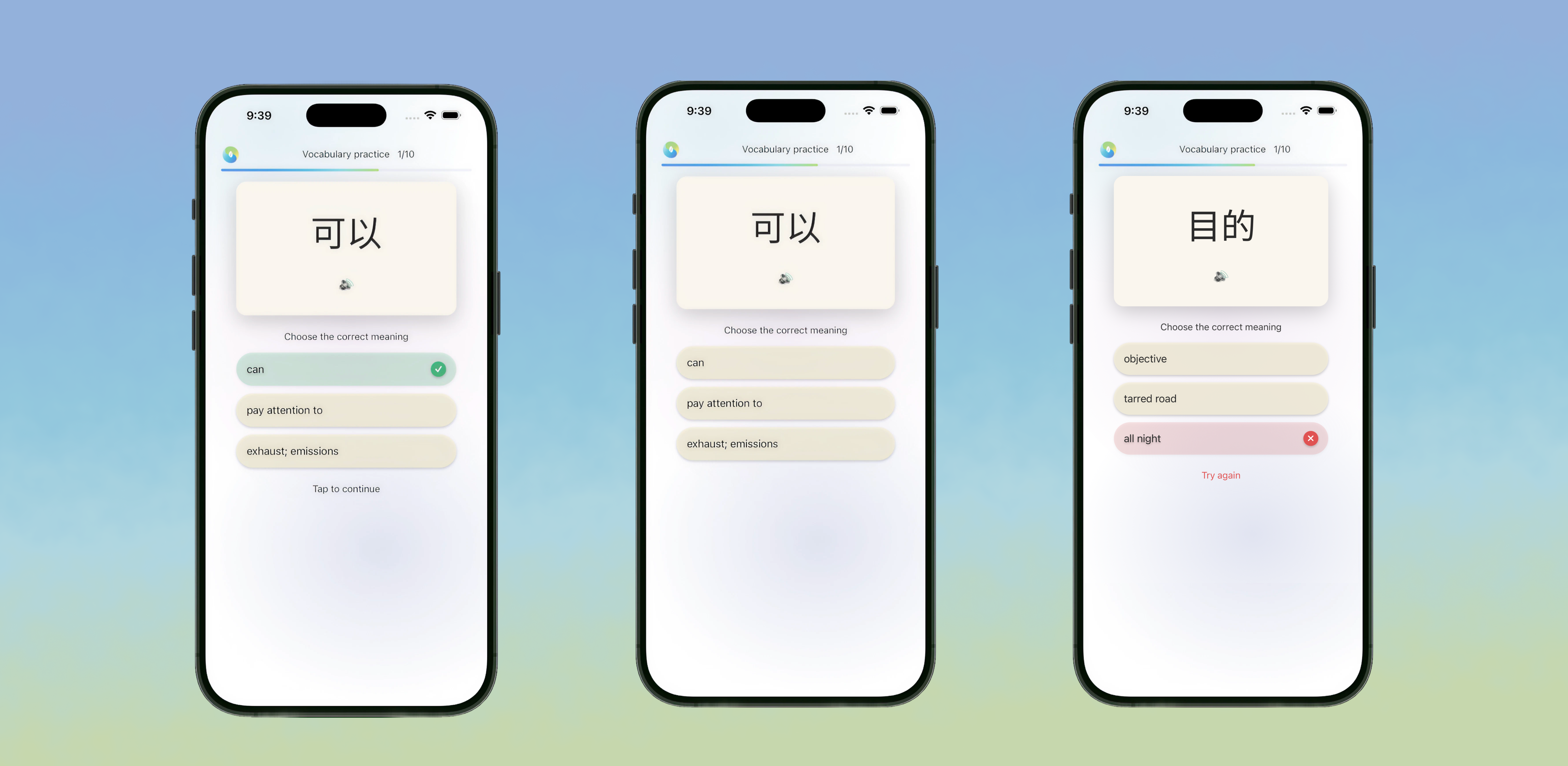
Three interaction states of vocabulary practice: Correct, Unanswered, and Wrong. There are no penalties or lost progress in any of these states.
Part 3: Sentences as the Confidence Reward
Every session ends with a single sentence. Its purpose is proof of ability rather than assessment. After reviewing individual characters and words, the sentence brings everything together into a readable, meaningful whole.
The sentence appears in Chinese first. A tap then reveals the English translation and an audio icon. The emotional function of this step is to reassure the learner that they can actually read real content.
Sentence selection is systematic. Each session identifies the character level and draws from a curated bank. I ensured that at least 80% of characters in any sentence are from levels the learner has already covered, providing the emotional payoff the entire session builds toward.
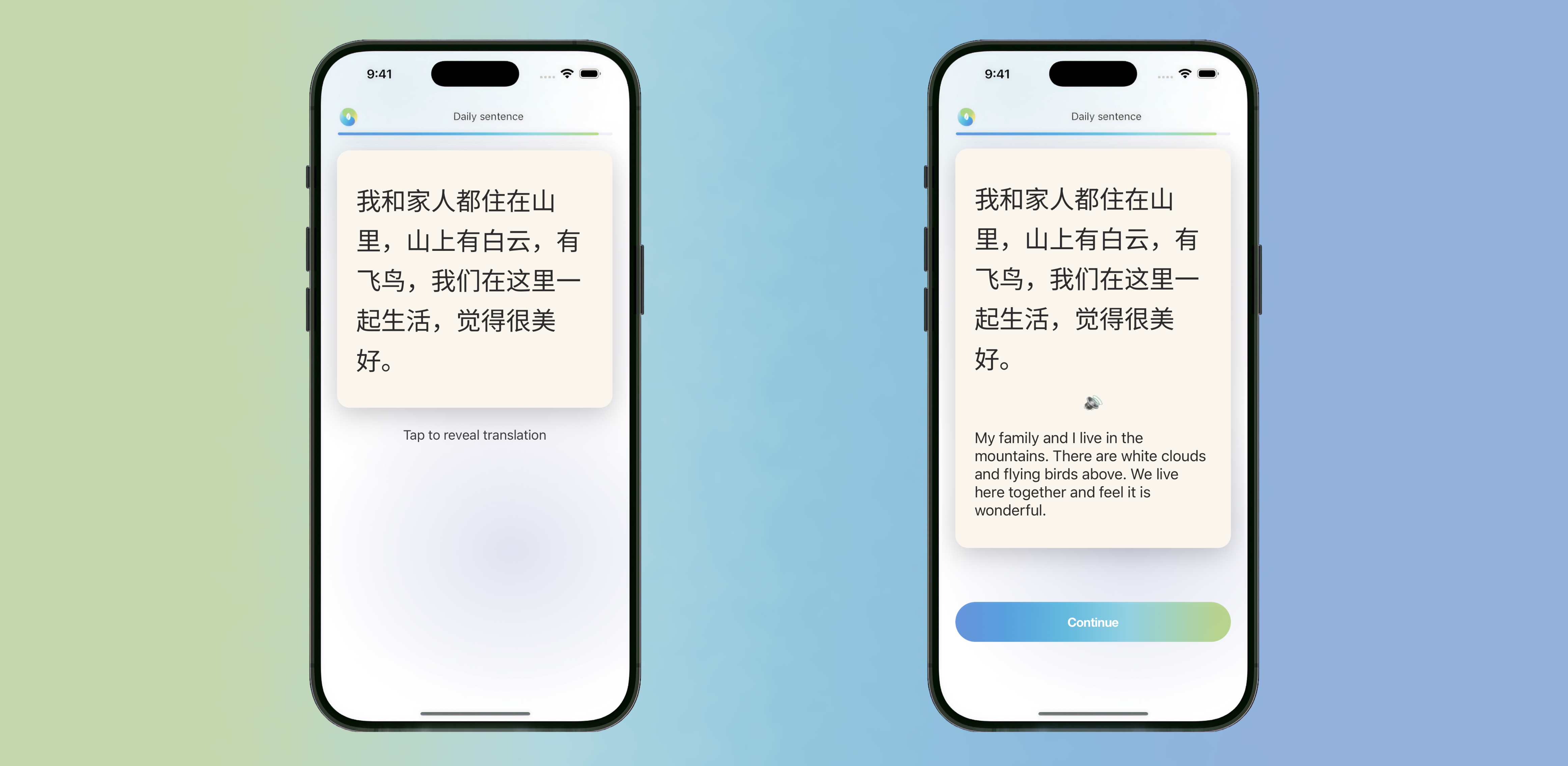
Phase 1: The sentence appears in Chinese only. Phase 2: A tap reveals the translation and audio. Listening is optional, preserving the visual-first nature of Chinese literacy.
Learner Control and Visibility
Two additional surfaces complete the experience: a settings panel for controlling daily workload and a weekly summary that translates progress into clear signals.
Customized Learning Pace
The only variable the learner controls is time. Four session length options map directly to character counts, while the system automatically handles what to review and when to introduce new characters. I decided to use a time budget rather than a raw “new characters per day” slider to respect learner agency while maintaining the integrity of the learning algorithm.
Learning Progress Report
Clarity on progress is essential for both independent and supported learners. Instead of complex dashboards or forgetting curves, I designed the weekly summary to provide reassurance that steady practice is working. Progress is reported in human language: “Foundation Growth,” “Memory Stability,” and “Reading Confidence” replace abstract metrics.
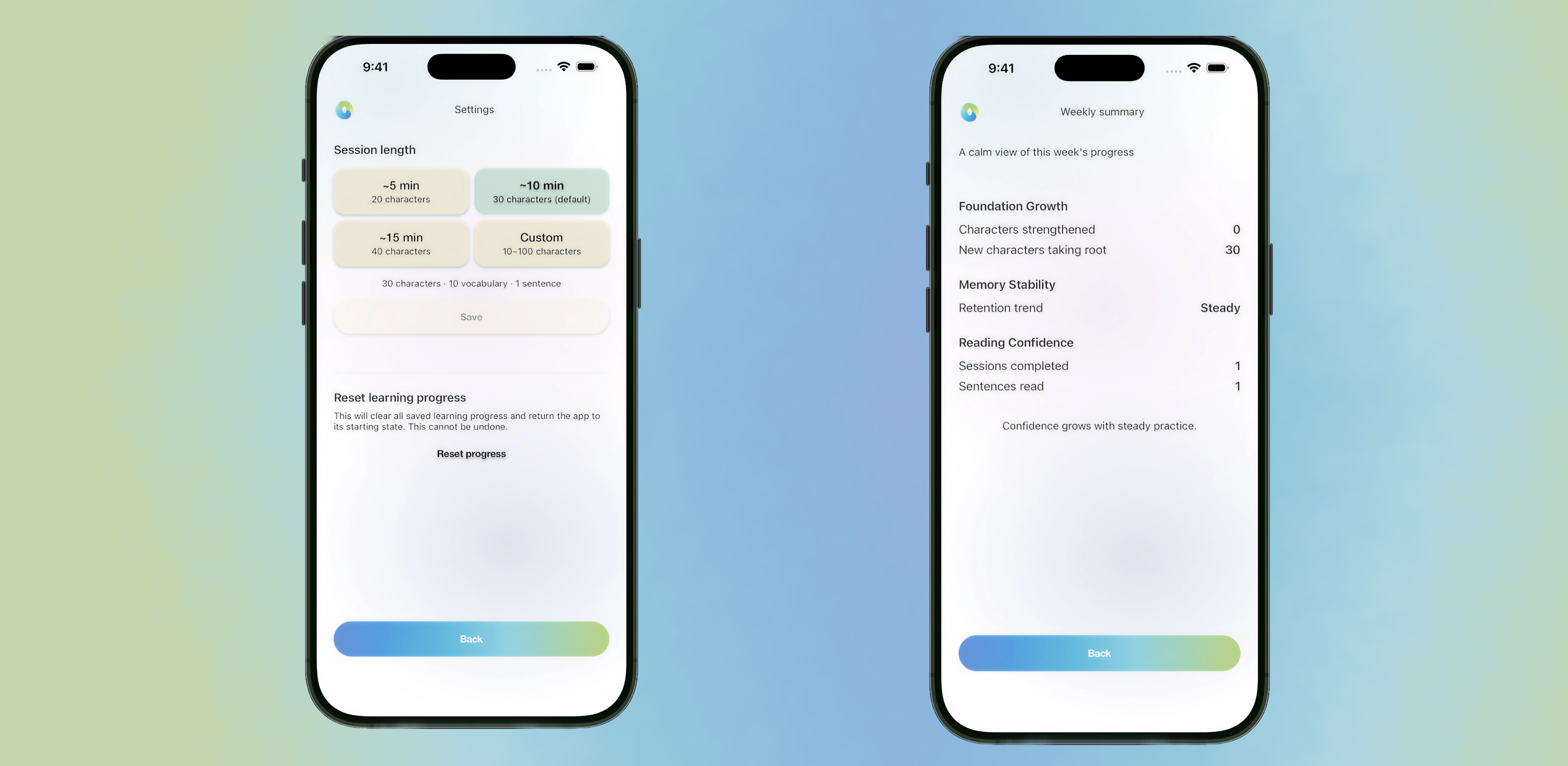
Left: Session length is the primary control. Right: Progress is reported in emotional language that learners can actually feel, rather than just scores.
Iteration: Insights from User Testing
I recruited 8 testers for a two-week TestFlight trial to observe their sessions and track usage patterns. The findings led to three significant shifts in both the pedagogy and the engineering of the product.
A. From Auto-Play to Passive Discovery
The original design auto-played audio immediately when a character was revealed. In testing, multiple learners noted that the automatic audio felt rushed or robotic. Some did not look at the character before the audio played, meaning the sound was becoming a crutch rather than a tool for learning.
Since Chinese characters must be learned as visual mappings, automatic audio was short-circuiting the cognitive path from visual form to meaning and finally to sound. I removed auto-play entirely and made audio tap-to-play, forcing the visual-first engagement the architecture required.
B. The Content Integrity Audit
The 2,500-character database and sentence bank included AI-generated content that could not always ensure universal appropriateness. I conducted a systematic full-dataset audit, using AI to flag entries and then manually reviewing them. I replaced unsuitable entries with culturally enriching alternatives like proverbs and nature imagery.
C. Normalizing Data Inconsistencies
Dictionary data often lacks consistent formatting, which adds unnecessary cognitive load for learners. I built a normalization pipeline to unify all metadata, including consistent case rules and standardized Pinyin formatting. While this work is invisible to users, it removed the subtle friction of an unpolished product.
Results and Impact
Data and feedback from the two-week TestFlight period provided a clear narrative of the product's impact.
Character recognition more than doubled after two weeks of daily use.
Validated by instructors and adopted as a supplementary learning tool for students.
Approved and shipped, from first design to public launch in 8 weeks.
User Testimonial
“I used One Grain to prepare for my Chinese AP test, studying about 15 minutes per day. Thanks to the app, I got a 5. My classmate who didn't use the app got a 3.”
Alice K., 10th grader
Reflections: The Discipline of Design Engineering
A. Strategic Constraint in the Age of AI
Building with AI as a daily partner accelerated this project significantly, but it also made scope creep more dangerous. AI makes it effortless to envision features that would have taken weeks to build manually.
The discipline required is not just technical but philosophical: knowing what to build, in what order, and exactly what to exclude for the current stage.
I made a deliberate decision to lock the V1 architecture early. That stability ensured the product remained coherent and focused on the core learning experience.
B. UX as Pedagogy Made Physical
The most important insight from this project is that every UX decision in an educational product is a pedagogical claim. The interface is simply the final encoding of a theory of learning.
Design Engineering at its best is the practice of ensuring that every interaction reflects an accurate understanding of how learners actually think, learn, and feel.
When I removed auto-play, I was not making a stylistic choice but correcting a pedagogical mistake. The pixels are just the final step in a much deeper cognitive strategy.
C. Translating Pedagogy into Deterministic Systems
One Grain taught me that the hardest part of building a learning product is not the interface, but understanding and correctly encoding the underlying cognitive science.
By designing for emotional safety as a technical requirement, rather than a UX nice-to-have, I built something that students actually wanted to return to.
The product's success came from knowing when to limit technology and when to amplify it. In a daily habit product, the only measure that matters is whether the learner comes back tomorrow.